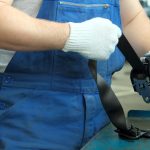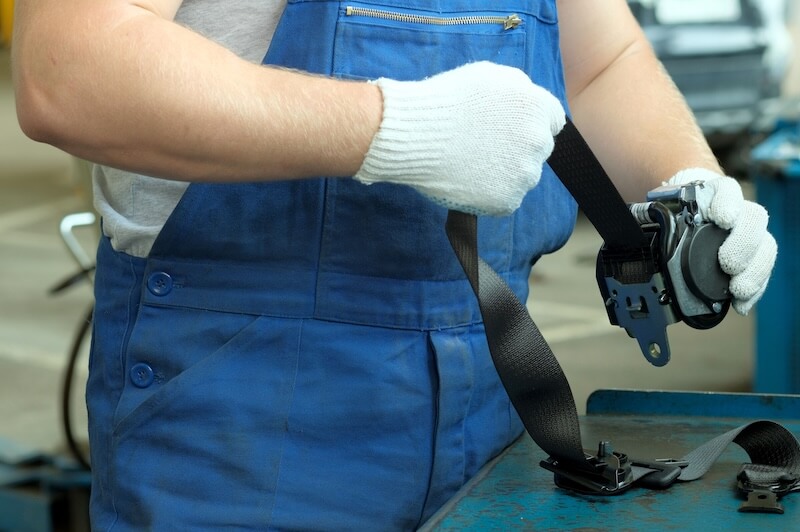
After a car accident, most drivers focus on the damage they can see. A dented door, a cracked bumper, broken glass, or a deployed airbag usually gets immediate attention. But there’s another part of your vehicle that deserves just as much consideration: the seat belts.
It’s easy to assume that if a seat belt still pulls out, clicks into its buckle, and retracts normally, it’s perfectly safe to use. Unfortunately, that’s not always the case. A collision can place enormous forces on a seat belt system, potentially affecting components that show no obvious signs of damage.
At OHS Body Shop, we believe drivers should understand why seat belt inspections are an important part of collision repair. After all, your seat belts are among the most important safety features in your vehicle. You want to know they’re ready to protect you if another accident happens.
What Happens to a Seat Belt During a Collision?
Seat belts are designed to restrain occupants during sudden deceleration. When a vehicle crashes, the occupants continue moving forward or sideways until something stops them. The seat belt helps control that movement and reduces the risk of striking the steering wheel, dashboard, windshield, or other parts of the vehicle.
During a collision, the belt can experience significant tension. The webbing stretches slightly as it absorbs energy, while the retractor and other components help manage the forces placed on the occupant.
Modern vehicles often have additional features designed to improve seat belt performance. One of the most important is the pretensioner. When activated, it rapidly tightens the belt to remove slack and help position the occupant more securely.
Some systems also include load limiters, which allow controlled belt payout under certain conditions to help manage forces on the occupant.
These components are engineered to work together. If one has been damaged or activated during a collision, the entire seat belt assembly may no longer perform as intended.
Why a Seat Belt Can Look Fine but Still Be Damaged
One of the biggest misconceptions about seat belts is that visible condition tells you everything you need to know.
In reality, damage can occur inside the retractor mechanism, at the anchor points, or within components that are hidden behind interior trim. The belt webbing itself may also have experienced forces that are not obvious to someone looking at it.
For example, a belt may still extend and retract after an accident, but that doesn’t necessarily mean its internal locking mechanism is functioning correctly. The retractor may have sustained damage, or a pretensioner may have activated and changed how the assembly operates.
The webbing can also be affected by cuts, fraying, heat, contamination, or deformation. Even small areas of damage can matter because the material is designed to withstand specific forces under controlled conditions.
This is why simply pulling on the belt and checking whether it clicks into place is not an adequate post-collision inspection.
What Is a Seat Belt Pretensioner?
A seat belt pretensioner is a device that helps tighten the seat belt during certain types of collisions. It is typically activated by the vehicle’s restraint control system when sensors detect conditions that meet the deployment criteria.
Depending on the vehicle, the pretensioner may be located in the seat belt retractor, buckle assembly, or another part of the restraint system.
When activated, it removes slack from the belt almost instantly. This helps reduce occupant movement and allows the seat belt and airbags to work together more effectively.
Many pretensioners use a one-time activation mechanism. Once deployed, they cannot simply be reset by pulling the belt back into position. The affected component must be handled according to the vehicle manufacturer’s repair instructions.
In some vehicles, pretensioner activation may also trigger requirements involving other restraint system components. These can include specific seat belt assemblies, control modules, wiring, or related hardware.
The exact requirements vary by vehicle. A technician needs to consult the correct manufacturer procedures rather than assume that every pretensioner system is the same.
When Should Seat Belts Be Replaced After an Accident?
There isn’t one universal rule that applies to every collision. Some minor accidents may not require seat belt replacement, while more serious crashes can require replacement of one or several assemblies.
If a pretensioner has activated, the affected assembly will generally require replacement according to the manufacturer’s instructions. If the belt webbing has been cut, frayed, burned, or otherwise damaged, it should not be treated as safe simply because the buckle still works.
The mounting points also matter. A collision can deform the floor, seat frame, pillar, or other areas where seat belts are anchored. Even a new seat belt assembly cannot provide the intended protection if it is attached to a damaged or improperly repaired mounting location.
Some manufacturers specify replacement of seat belt assemblies that were in use during a collision involving airbag or pretensioner deployment. Others provide more specific inspection and replacement criteria.
The National Highway Traffic Safety Administration advises that seat belt assemblies be inspected after a crash because they may have been stressed or damaged. It also notes that replacement may be necessary even when the damage is not immediately apparent.
The safest approach is to follow the vehicle manufacturer’s instructions for the specific collision and restraint system.
What About Seat Belts That Were Not Being Used?
It might seem logical that a seat belt that wasn’t being worn during an accident would automatically be unaffected. However, that isn’t necessarily true.
The collision may have damaged the seat, retractor mounting location, belt anchor, or surrounding body structure. A belt that was not being used could still have been exposed to impact forces or affected by damage to its mounting area.
For example, a side impact could deform a pillar or damage the structure where a rear seat belt is attached. A rollover could affect roof-mounted components and other restraint system hardware.
That doesn’t mean every unused seat belt needs to be replaced after every collision. It means the inspection should consider the location and type of impact, the vehicle’s design, and the manufacturer’s repair instructions.
Why Seat Belt Mounting Points Matter
Seat belts are only as reliable as the structures that hold them in place.
The anchor points are engineered to withstand substantial forces during a crash. Depending on the vehicle, these may be attached to the floor, pillars, seat frames, or other structural sections.
After a collision, technicians need to check for signs of deformation, cracks, torn metal, damaged threads, or other problems around these mounting locations. Fasteners may also have specific replacement requirements.
If the surrounding structure has been damaged, repairing or replacing the belt alone may not be enough. The mounting area must also be restored according to the manufacturer’s procedures.
This is one reason collision repair involves much more than replacing visible exterior panels. Our article on cosmetic versus structural damage explains why damage behind the visible surface can have a direct impact on vehicle safety.
Can You Replace a Seat Belt With a Used One?
A used seat belt may look like an inexpensive alternative, especially when the vehicle has sustained extensive damage. However, restraint system components are safety-critical parts, and appearance alone cannot confirm that a used assembly is suitable.
A salvaged belt may have been involved in a previous collision, exposed to damaging conditions, or removed improperly. It may also have a different part specification from the original component.
The National Highway Traffic Safety Administration has highlighted concerns about salvaged airbags and the importance of proper replacement procedures. The broader lesson applies to restraint system repairs: the origin, condition, compatibility, and installation requirements of safety components matter.
Drivers should ask their repair shop to follow the vehicle manufacturer’s requirements for replacement parts and avoid making decisions based only on price.
Why a Complete Restraint System Inspection Matters
Seat belts don’t operate independently. They work with airbags, sensors, control modules, and other safety systems to help protect occupants.
If a collision triggers a pretensioner or airbag, the vehicle may require additional inspection and diagnostic work. The restraint system should be checked for stored faults, damaged wiring, affected sensors, and any components that the manufacturer requires to be replaced.
A warning light is useful, but it should not be the only measure of whether a vehicle’s safety systems are ready. Proper inspection and repair procedures are essential.
This is particularly important in modern vehicles, where safety systems are increasingly interconnected and may involve complex electronic controls.
Don’t Overlook the Safety Features You Use Every Day
After an accident, it’s natural to want your vehicle repaired quickly. But getting back on the road should mean more than having the dents removed and the paint restored.
Your seat belts need to function correctly every time you drive. If they’ve been exposed to collision forces, a proper inspection can help identify damage that might otherwise go unnoticed.
At OHS Body Shop, we understand that quality collision repair means looking beyond what is visible. From damaged body panels to structural components and vehicle safety systems, every part of the repair matters.
If you’ve been involved in an accident in Kalispell, Whitefish, Columbia Falls, Polson, or the surrounding Flathead Valley, have your vehicle inspected by an experienced collision repair team. Don’t assume your seat belts are safe just because they look normal. Make sure they’re ready to do their job when you need them most.