


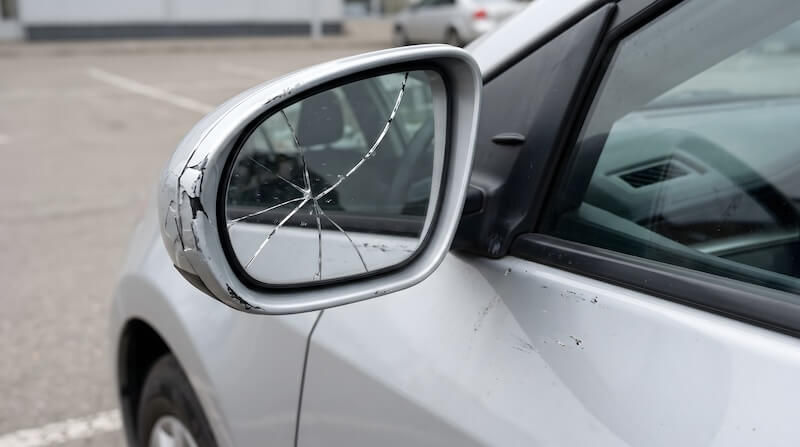
A damaged side mirror might seem like one of the simplest repairs after a car accident. The mirror gets hit, the housing cracks, or the entire assembly breaks away. Replace the damaged part, reconnect the wiring, and the job should be finished.
That might have been true for older vehicles with basic manually adjusted mirrors. But modern side mirrors can contain a surprising amount of technology.
Depending on the vehicle, a side mirror may include heating elements, power adjustment motors, folding mechanisms, blind spot monitoring indicators, cameras, turn signals, memory functions, and other electronic components.
Some mirrors are also connected to advanced driver-assistance systems that help drivers detect vehicles and obstacles around them.
This means replacing a damaged mirror can involve much more than installing a new piece of glass.
At OHS Body Shop, we understand that even relatively small collision repairs can involve important safety technology. Here’s what makes modern side mirror replacement more complicated than many drivers expect.
How Side Mirrors Have Changed Over the Years
Older vehicle mirrors were relatively simple.
A basic side mirror consisted of a reflective glass surface mounted inside a housing. Drivers adjusted it manually, and its primary purpose was to provide a view of traffic alongside and behind the vehicle.
Power-adjustable mirrors later became common, allowing drivers to change the mirror position using an interior switch.
Modern mirrors have evolved considerably.
Today, many vehicles offer features such as automatic folding, heating, integrated turn signals, memory settings, blind spot warning indicators, and cameras.
Some vehicles even use side-mounted cameras as part of a surround-view parking system.
These features improve convenience and visibility, but they also make the mirror assembly more complex and potentially more expensive to repair.
What Components Are Inside a Modern Side Mirror?
The exact components depend on the vehicle, but a modern side mirror may contain several electrical and mechanical systems.
The mirror glass may include heating elements that help remove fog or frost during cold weather.
Small electric motors allow the driver to adjust the mirror position. Other motors may control automatic folding.
Some assemblies include memory functions that store preferred mirror positions for different drivers.
Integrated turn signals provide additional visibility to other road users, while warning indicators may illuminate when another vehicle is detected in the driver’s blind spot.
More advanced designs may include cameras, puddle lights, temperature sensors, and other equipment.
All these components are connected through wiring that runs into the vehicle’s door.
A collision can damage more than the visible mirror housing. It may also affect internal wiring, mounting points, connectors, and related electronic systems.
Why Blind Spot Monitoring Matters
Blind spot monitoring is one of the most useful technologies associated with modern vehicle mirrors.
The system generally uses radar sensors or other detection technology positioned around the vehicle to monitor areas that may not be easily visible in conventional mirrors.
When another vehicle is detected in a driver’s blind spot, a warning indicator may illuminate on the corresponding side mirror.
Some systems provide additional alerts if the driver activates the turn signal while another vehicle is present.
If a collision damages the mirror assembly, its indicator, wiring, or associated sensors, the system may not operate as intended.
It’s important to understand that the radar sensor itself is often located elsewhere on the vehicle, such as behind the rear bumper or in another designated area. The mirror may simply display the warning.
Therefore, replacing the mirror doesn’t necessarily resolve every blind spot monitoring problem. The entire system may need inspection and diagnostic checks.
Our article on the role of advanced driver-assistance systems in collision repairs explains why modern safety technology requires attention after an accident.
What About Cameras Built Into Side Mirrors?
Some modern vehicles use cameras mounted underneath or within the side mirror assemblies.
These cameras may form part of a surround-view system that combines images from several cameras to create a view around the vehicle.
This can be especially useful when parking, maneuvering in tight spaces, or checking the area around the vehicle.
If a mirror-mounted camera is damaged or replaced, the system may require inspection, adjustment, or calibration according to the manufacturer’s procedures.
Even a small change in camera positioning can affect how the system combines images.
For example, the camera may appear to work, but the resulting image could have distorted alignment or an incorrect view of the surrounding area.
A proper repair should confirm that the camera and the overall system function as intended.
Why the Correct Replacement Mirror Matters
Not every mirror assembly that physically fits a vehicle is necessarily compatible with its equipment.
A particular vehicle model may have several mirror configurations depending on the trim level and optional features.
One version might have basic power adjustment, while another includes heating, automatic folding, blind spot indicators, memory settings, and a camera.
Using an incorrect replacement assembly can result in missing features or electrical compatibility problems.
Even when the replacement mirror looks identical from the outside, its internal components and connectors may differ.
The replacement part should match the vehicle’s specifications and equipment requirements.
This is particularly important for newer vehicles where mirror assemblies are integrated into multiple electronic systems.
Why Mirror Mounting Points Need Inspection
When another vehicle strikes a side mirror, the impact can transfer force into the door.
The mirror is generally attached through a mounting area near the front of the door, often behind an interior trim panel.
A hard impact may damage the mounting studs, mounting plate, surrounding metal, or interior attachment points.
If the mirror is replaced without checking the mounting area, the new assembly may not sit correctly.
Drivers may notice that the mirror vibrates while driving, doesn’t fold properly, or sits at an unusual angle.
The door itself may also have sustained damage around the mounting location.
This is why technicians should inspect the attachment area rather than simply installing a replacement mirror.
How Weather and Heating Features Affect Mirror Repairs
Heated mirrors are particularly useful in Montana, where cold mornings, frost, and winter weather can affect visibility.
These mirrors contain heating elements that help clear condensation and ice from the glass surface.
If the mirror is damaged, the heating element may be affected even when the glass still appears intact.
A replacement assembly needs to have the correct heating capability, and the electrical connections should be checked.
Automatic folding mechanisms also deserve attention. A collision may damage the folding motor or internal gears, even if the mirror housing can still be moved manually.
Replacing the wrong version of the assembly could leave the vehicle without features that were originally installed.
What Happens When the Mirror Is Part of a Surround-View System?
Some vehicles use multiple cameras to create a bird’s-eye view of the area around the vehicle.
These systems commonly combine front, rear, and side camera images.
The cameras need to be positioned accurately so that the system can combine their images correctly.
If a side mirror camera is replaced or disturbed, calibration may be necessary.
Depending on the manufacturer, this may involve dedicated calibration targets, specialized equipment, and specific software procedures.
The same principle applies to other camera-based driver-assistance systems. A camera that appears to work normally may still provide inaccurate information if its alignment is incorrect.
Our article on ADAS sensor recalibration after a collision explains why calibration is an important consideration after certain vehicle repairs.
Why Insurance Estimates May Include More Than the Mirror
A driver might expect an insurance estimate to include only the replacement mirror assembly and installation.
However, the actual repair may involve additional operations.
The door may need inspection for damage around the mounting points. Wiring or connectors may need replacement. Cameras may require calibration, and related systems may need diagnostic checks.
If the mirror was struck during a larger side-impact collision, the door, fender, and surrounding structure may also be affected.
These additional operations may become apparent only after the damaged components are removed.
Our article on why some collision repairs require supplements explains why repair estimates can change when additional damage or required procedures are identified.
Can You Drive With a Damaged Side Mirror?
The answer depends on the extent of the damage and the applicable vehicle equipment and legal requirements.
A mirror with cracked glass may provide a distorted view, while a mirror that has broken away completely can reduce visibility on that side of the vehicle.
A damaged housing may also have exposed electrical connections or loose components.
Even if the vehicle remains mechanically drivable, reduced visibility can make changing lanes, parking, and checking surrounding traffic more difficult.
If a mirror is badly damaged, it is best to have it repaired or replaced promptly. Drivers should also check applicable Montana requirements concerning required mirrors and visibility before operating the vehicle.
Getting Modern Side Mirrors Repaired Properly
A modern side mirror is much more than a reflective piece of glass. It can be connected to several systems that affect visibility, convenience, and driver assistance.
After a collision, the mirror assembly, mounting points, wiring, cameras, and related technology may all need attention.
At OHS Body Shop, we believe even smaller collision repairs deserve proper evaluation. Replacing the visible component is only part of the job if other systems have also been affected.
If your vehicle has sustained side mirror damage in Kalispell, Whitefish, Columbia Falls, Polson, or the surrounding Flathead Valley, have it inspected by an experienced collision repair team.
The mirror may be small, but its role in keeping you aware of what’s happening around your vehicle is anything but minor.