When you think about collision repair, you might picture technicians hammering out dents, replacing damaged panels, and applying fresh paint. But one of the most important parts of putting a modern vehicle back together happens where you can’t easily see it: the joints connecting the body components.
Today’s vehicles are engineered using a combination of materials and joining methods. Depending on the manufacturer and model, a vehicle may use traditional welding, structural adhesives, rivets, or a combination of these techniques.
These methods aren’t interchangeable. Each has specific applications, advantages, and limitations. Choosing the wrong joining method or using it incorrectly can affect the strength and performance of the repaired vehicle.
At OHS Body Shop, we understand that modern collision repair requires more than knowing how to work with metal. It also means understanding how the vehicle was originally designed and following the appropriate repair procedures.
Why Modern Vehicles Use Different Joining Methods
Vehicle manufacturers are constantly working to balance safety, weight, durability, fuel efficiency, and production costs.
Older vehicles relied heavily on conventional steel construction and traditional welding methods. Modern vehicles, however, may combine different grades of steel, aluminum, plastics, and other engineered materials.
These materials don’t all behave the same way. Some require carefully controlled heat during joining, while others are better suited to adhesive bonding or mechanical fastening.
Manufacturers therefore use different methods depending on the location of a component, the materials involved, and the structural requirements of the vehicle.
The same vehicle may use resistance spot welding in one area, structural adhesive in another, and rivets in a third.
During collision repair, the replacement process needs to respect this original design.
What Is Welding in Collision Repair?
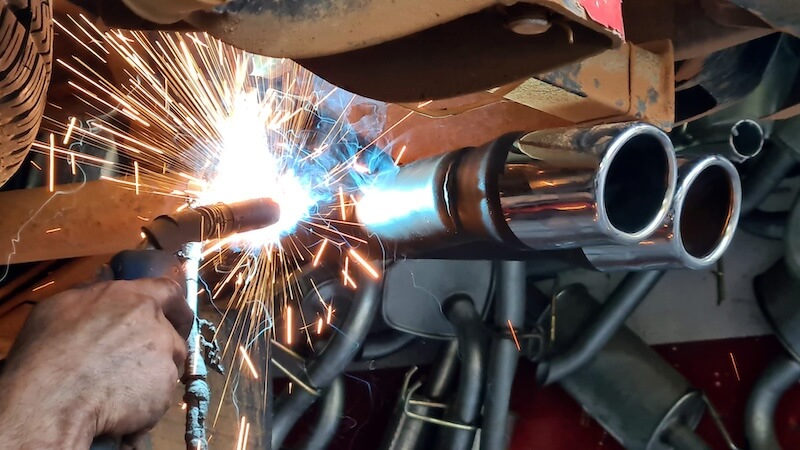
Welding is a process that joins metal components by creating a strong connection between them, usually through heat.
Several welding methods are used in automotive manufacturing and collision repair.
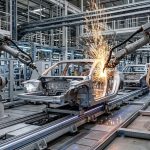
Resistance spot welding is one of the most familiar. It uses electrical current and pressure to join overlapping metal sheets at specific points. Factory vehicles often have many spot welds connecting body panels and structural components.
MIG welding is another method used in certain automotive repairs. It uses an electric arc and a consumable wire electrode to create a welded joint.
However, not every type of steel or vehicle component can be repaired using the same welding method. Some advanced high-strength steels have restrictions on welding locations, heat input, or repair procedures.
Technicians must consult the manufacturer’s repair information to determine which method is appropriate.
What Are Structural Adhesives?
Structural adhesives are specially engineered bonding materials used to join vehicle components.
Unlike ordinary household glue, automotive structural adhesives are designed to meet demanding requirements involving strength, durability, vibration, and environmental exposure.
They are used in various vehicle applications, including certain body panel joints, roof assemblies, and structural connections.
One advantage is that adhesives can distribute loads across a larger bonded surface instead of concentrating them at individual weld points.
They can also help reduce vibration and contribute to sealing against moisture.
However, structural adhesives are not simply applied wherever a technician wants a stronger joint. Their use depends on the manufacturer’s design and repair specifications.
The correct adhesive type, surface preparation, application thickness, curing conditions, and installation process all matter.
How Adhesives and Welding Work Together
In many modern vehicles, the answer isn’t choosing between adhesive bonding and welding. Manufacturers often use both.
This approach is commonly referred to as weld bonding.
In a weld-bonded joint, structural adhesive is applied between components, and welding is used at specified locations to create the required connection.
The adhesive helps distribute loads along the joint, while the welds provide additional mechanical connection.
Some repairs also involve rivets alongside adhesives. This is particularly relevant for certain aluminum-intensive vehicle designs, where conventional welding may not be the preferred joining method.
The exact combination depends on the vehicle’s original construction and the manufacturer’s approved repair procedures.
Why Rivets Are Used in Some Modern Vehicles
Rivets are mechanical fasteners that join two or more components by passing through aligned holes and securing the materials together.
Automotive manufacturers use different types of rivets depending on the application. These may include self-piercing rivets and other specialized fasteners designed for particular materials and joint configurations.
Riveting can be useful when joining materials that are difficult to weld using conventional techniques.
For example, certain aluminum body structures use rivets combined with structural adhesives.
This doesn’t mean any rivet can be used in any repair. The type, size, location, installation method, and equipment must match the manufacturer’s requirements.
Using the wrong fastener or installing it incorrectly can compromise the joint.
Why You Can’t Simply Replace Welding With Adhesive
It might sound tempting to assume that adhesives are always better because they distribute forces over a larger area. But that isn’t how automotive structural repair works.
Each joining method is designed for particular materials and applications.
Some joints are specifically engineered to be welded. Others require adhesive bonding or a combination of joining techniques.
Using adhesive where welding is required may produce a connection that doesn’t perform as intended. The reverse is also true: welding in an area designed for adhesive bonding can introduce excessive heat or damage nearby materials.
Heat can also affect coatings, electrical components, interior materials, and the properties of certain advanced steels.
The correct repair method must therefore come from the vehicle manufacturer’s procedures, not personal preference or convenience.
Why Surface Preparation and Curing Matter
Structural adhesive performance depends heavily on how the materials are prepared and installed.
The bonding surfaces need to be clean and prepared according to the product and vehicle requirements. Contamination, incorrect application, or poor surface preparation can weaken the connection.
Curing is equally important.
Some adhesives require specific temperatures and curing times before the repaired assembly can be subjected to further work or loading. Others have different requirements depending on the product and conditions.
Technicians must follow the adhesive manufacturer’s instructions and the vehicle manufacturer’s repair procedures.
Rushing this process can compromise the finished repair.
How These Methods Affect Vehicle Safety
The way vehicle components are joined can influence how the body behaves during a collision.
Modern vehicle structures are designed to manage crash forces through specific load paths and controlled deformation zones.
If a repaired joint is weaker, stiffer, or located differently from the original design, it may affect how forces are transferred during another collision.
This is particularly important around structural areas such as pillars, rocker panels, roof rails, and other sections that contribute to passenger compartment protection.
Our article on how crash energy travels through your vehicle during a collision explains why the vehicle’s structural design matters so much.
Why Manufacturer Repair Procedures Are Essential
Every vehicle has its own construction details and repair requirements.
The manufacturer may specify particular welding equipment, adhesive products, rivets, sectioning locations, or curing conditions.
These instructions can also differ between model years and even between different versions of the same model.
A repair method that is acceptable for one vehicle may not be suitable for another.
This is why technicians need access to accurate repair information before carrying out structural work.
Our article on understanding OEM repair procedures explains why manufacturer instructions are such an important part of quality collision repair.
Getting Modern Collision Repairs Done Properly
Modern vehicles are more sophisticated than ever, and collision repair techniques have evolved alongside them.
Welding remains important, but adhesives and mechanical fastening methods have become essential parts of modern vehicle construction.
The goal isn’t to use the newest or most convenient technique. It’s to use the correct method for the specific vehicle and repair.
At OHS Body Shop, we understand that quality collision repair involves attention to the details behind the finished exterior. Proper joining methods help ensure that repaired components are installed according to the vehicle’s design.
If your vehicle has suffered structural damage in Kalispell, Whitefish, Columbia Falls, Polson, or the surrounding Flathead Valley, have it evaluated by an experienced collision repair team.
A good repair should look right, but it also needs to respect the engineering that went into building your vehicle in the first place.