


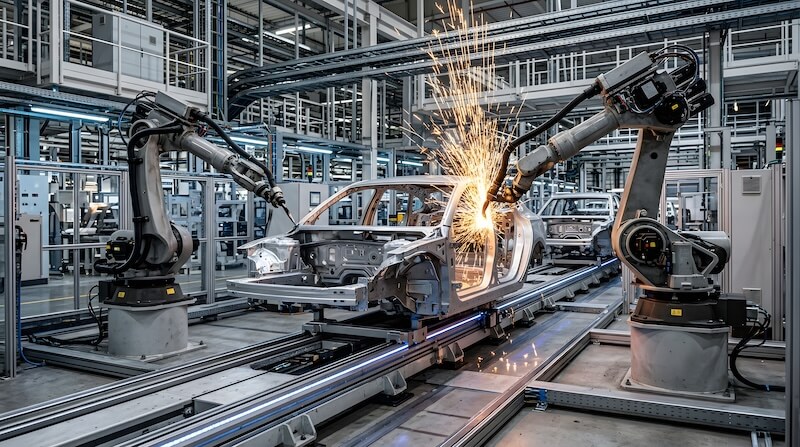
Modern vehicles are designed to protect occupants while balancing weight, performance, fuel efficiency, and durability. One of the materials that makes this possible is high-strength steel.
You may not think much about the metal underneath your vehicle’s paint, but it plays a major role in how your car responds during a collision.
Manufacturers use different grades of steel throughout a vehicle’s structure. Some sections are designed to deform in a controlled way, while others are intended to maintain the integrity of the passenger compartment.
This engineering creates a challenge for collision repair technicians. Not all steel can be straightened, heated, welded, or replaced using the same methods.
At OHS Body Shop, we understand that repairing modern vehicles means understanding the materials used in their construction. Here’s why high-strength steel matters and what drivers should know when their vehicle needs structural repairs.
What Is High-Strength Steel?
High-strength steel is a category of steel engineered to provide greater strength than conventional mild steel.
In automotive applications, it allows manufacturers to design components that can withstand substantial forces while helping reduce vehicle weight.
There are several types of high-strength steel, and they don’t all have the same properties.
Conventional high-strength steel is used in various vehicle components, while advanced high-strength steel and ultra-high-strength steel are designed for more demanding applications.
Some modern vehicles also use specialized grades such as press-hardened steel, which can provide very high strength in relatively thin sections.
The exact materials used depend on the vehicle’s manufacturer, model, year, and structural design.
Why Car Manufacturers Use Different Grades of Steel
A modern vehicle isn’t designed to behave the same way in every part of a collision.
Instead, engineers develop a structure that manages impact forces through specific areas.
Some sections are designed to absorb energy by deforming in a controlled manner. Other areas are intended to remain strong enough to help protect occupants.
For example, the front of a vehicle typically incorporates energy-absorbing structures that help manage the forces of a frontal collision.
The passenger compartment, meanwhile, is designed to maintain its integrity as much as possible.
Using different steel grades allows manufacturers to balance these requirements.
High-strength materials can help reinforce areas where additional strength is needed without making the entire vehicle excessively heavy.
Where Is High-Strength Steel Found in Modern Vehicles?
High-strength steel can be used throughout a vehicle’s body and structural assembly.
Depending on the design, it may be found in door intrusion beams, roof rails, pillars, rocker panels, floor reinforcements, and other structural sections.
The A-, B-, and C-pillars are particularly important because they contribute to the passenger compartment’s structure.
Some vehicles use ultra-high-strength or press-hardened steel in specific areas where engineers want to provide substantial resistance to deformation.
However, there is no universal layout. Two vehicles that look similar from the outside may use very different materials in their structural construction.
This is why technicians need access to vehicle-specific material information before beginning structural repairs.
Why High-Strength Steel Is More Difficult to Repair
One of the biggest challenges with high-strength steel is that its properties can be affected by certain repair processes.
Conventional steel may tolerate some straightening or heating techniques that are not permitted on particular advanced high-strength materials.
Applying excessive heat can change the material’s strength and other mechanical properties. Straightening a component beyond the manufacturer’s limits may also compromise its ability to perform as designed.
In some cases, a damaged section must be replaced rather than pulled or reshaped.
The manufacturer may also specify restrictions on where cutting and sectioning are allowed.
These limitations exist because the material’s strength is part of the vehicle’s safety engineering.
A repair that restores the panel’s appearance but compromises its material properties isn’t a proper structural repair.
Why Heat Can Be a Problem
Heat is commonly used in certain metalworking and welding processes. However, high-strength steel can be sensitive to heat input.
Depending on the grade and manufacturing process, heating may alter the steel’s original properties.
For example, press-hardened steel is manufactured through a controlled heating and forming process. Applying heat during an unauthorized repair could change its characteristics.
That is why manufacturers often provide specific instructions about whether a component can be heated, straightened, welded, or sectioned.
Technicians must identify the material before choosing a repair method.
Using a general metal repair technique without checking the material specifications can lead to problems that aren’t visible after the vehicle has been painted.
How High-Strength Steel Affects Welding
Welding is still an important part of automotive collision repair, but modern steel requires more precise procedures.
Different steel grades may require specific welding equipment, settings, wire types, and preparation methods.
Resistance spot welding is commonly used in vehicle manufacturing, while collision repair may involve approved spot welding or other joining techniques depending on the component.
Some manufacturers restrict certain welding processes in specific structural areas.
The number and location of welds also matter. A replacement panel needs to be joined in the locations and using the methods specified for that vehicle.
Our article on structural adhesives versus welding in collision repair explains why different joining methods are used in modern vehicle construction.
Why Structural Measuring Is So Important
When a vehicle experiences a significant collision, technicians need to determine whether its structural dimensions have changed.
High-strength steel components can be damaged even when the deformation isn’t obvious from the outside.
Specialized electronic measuring systems can help technicians compare the vehicle’s dimensions with the manufacturer’s specifications.
This is particularly important when the collision affects pillars, rocker panels, floor structures, suspension mounting areas, or other critical sections.
Accurate measurement helps establish the extent of the damage and guides the appropriate repair plan.
Our article on frame straightening and its impact on vehicle safety and performance explores why structural accuracy matters after an accident.
Why Replacement May Be Better Than Straightening
In some cases, replacing a damaged high-strength steel component is the correct approach.
The decision depends on the material, the location and extent of the damage, and the manufacturer’s repair requirements.
A technician may be able to repair a damaged section using an approved method. In other situations, the manufacturer may require replacement of the affected component or assembly.
Replacement is not necessarily a sign that the damage was extreme or that the repair shop is taking an unnecessarily expensive approach.
It may simply be the only approved way to restore the component’s intended properties.
The important thing is that the decision is based on accurate vehicle information rather than assumptions.
What Does This Mean for Vehicle Owners?
For drivers, the main takeaway is that modern collision repair is highly vehicle-specific.
A repair method that worked perfectly on an older vehicle may not be appropriate for a newer model built with advanced materials.
This also explains why collision estimates can vary considerably. Two vehicles with similar-looking damage may require very different repair operations depending on their construction.
It’s worth asking your repair shop how the damage will be evaluated and whether the repair plan follows the manufacturer’s procedures.
Our article on why repair estimates change after tear-down explains why additional inspection can reveal damage and repair requirements that aren’t visible during the initial estimate.
Why Experience and Proper Repair Information Matter
High-strength steel has made modern vehicles safer and more efficient, but it has also made collision repair more specialized.
Technicians need to understand the different material types, their repair limitations, and the joining methods required for each application.
The right equipment is important, but so is access to accurate manufacturer information and the ability to follow it correctly.
At OHS Body Shop, we believe quality collision repair means understanding what is underneath the surface and using the appropriate procedures to restore the vehicle.
If your vehicle has sustained structural damage in Kalispell, Whitefish, Columbia Falls, Polson, or the surrounding Flathead Valley, have it inspected by an experienced collision repair team.
The metal beneath your vehicle’s paint is doing an important job. Making sure it is repaired properly is an important part of getting your vehicle safely back on the road.